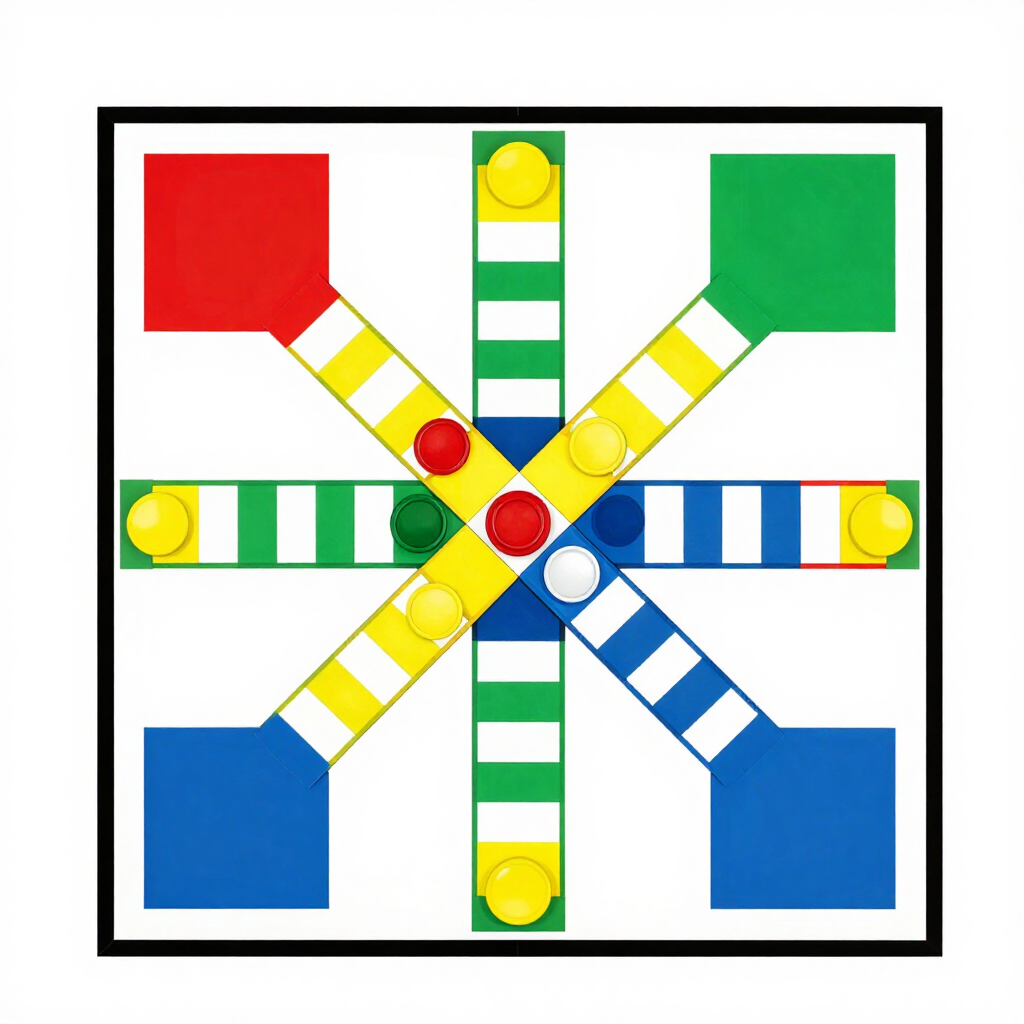
Ludo
Roll the dice, release your tokens, and race them home
Difficulty
You play red. Click Roll, then click a token to move it. You need a 6 to release a token from base — and a 6 grants another turn. Land on the computer's token on the shared track to send it home. Get both tokens to the finish to win. The computer plays blue.
Shared track (28 squares)
You (red)
Computer (blue)
About Ludo
Objective
Get both of your tokens safely home before the computer does.
Who it’s for
Families and players of about 6 and up who enjoy a race game with a little strategy and a lot of dice luck.
What makes it interesting
Ludo mixes luck and choice: the dice decide how far you move, but you choose which token to move — and landing on the computer sends it all the way back to base.
How to play
- 1Click Roll to roll the die. You need a 6 to release a token from base onto the track.
- 2After rolling, click one of your tokens to move it that many squares forward.
- 3Rolling a 6 grants another turn — but three sixes in a row forfeit it.
- 4Land on the computer's token on the shared track to send it back to base.
- 5Get both of your tokens to the finish (through the home stretch) to win.
Tips & strategy
- Roll a 6 early to get a token out of base — tokens stuck in base can't score.
- Spread your tokens out so a single capture can't doom both at once.
- Capturing the computer sends it all the way home, so set up landings on occupied squares.
- Once a token reaches the home stretch it's safe from capture, so push leaders home first.
Rules
- You play red and move first; the computer plays blue.
- Click Roll to roll the die. You need a 6 to release a token from base onto the track.
- After rolling, click one of your tokens to move it that many squares forward along the shared track.
- Rolling a 6 grants another turn, but three sixes in a row forfeit it.
- Land on the computer's token on the shared track to send it back to base.
- Once a token travels all the way around, it enters the home stretch toward the finish. Get both tokens to the finish to win.
Setup
- 1Each side has two tokens, both starting in base.
- 2A shared track loops around the board; each side has its own home stretch leading to the finish.
- 3Choose a difficulty level to adjust the computer's play.
Quick start
- 1Click Roll, then click a token to move it.
- 2Roll a 6 to release a token from base.
- 3Land on the computer's token to send it home.
- 4Guide both tokens through the home stretch to the finish.
Turn order & scoring
- 1You play red and move first.
- 2Click Roll, then click one of your tokens to move it.
- 3The computer then rolls and moves a blue token.
- 4Rolling a 6 grants another turn; otherwise play alternates until both of one side's tokens are home.
Accessibility notes
- Tokens are colour-coded red and blue with clear numbering.
- Movable tokens pulse when it is your turn, so you always know what you can play.
- There is no timer — take as long as you like to choose a token.
- The shared track is numbered, helping players follow the race at a glance.
History & facts
- Ludo is a simplified descendant of Pachisi, a cross-shaped race game from India.
- Pachisi is centuries old and was reportedly played at royal courts with large boards.
- The game was adapted in England and patented as 'Ludo' in 1896.
- Many cultures have their own variations of the same race-to-home idea.
Frequently asked questions
How do you win Ludo?
Get both of your tokens to the finish, through the home stretch, before the computer gets both of its tokens home.
Do you need a 6 to start in Ludo?
Yes. You must roll a 6 to release a token from base onto the track, and a 6 also grants you another turn.
What happens when you land on an opponent's token?
The opponent's token is sent all the way back to its base and must be released again with a 6.
Is Ludo a game of luck or skill?
Both. The dice decide how far you move, but you choose which token to move and when to capture, so good choices matter.
Where does Ludo come from?
Ludo descends from the ancient Indian game Pachisi and was patented under the name Ludo in England in 1896.
More puzzles to try
Guides & how-tos
Go deeper with practical guides on teaching board games, planning a family game night, beginner strategy, and making play accessible for older players.